The Brussels Shakespeare Society presents

Antony &
Cleopatra

by William Shakespeare  ·  directed by Patrick Stephenson

19 – 23 May 2026

Centre Culturel Jacques Franck  ·  Brussels

19–22 May at 8pm  ·  23 May at 2pm & 8pm

Surtitles mostly in French and Dutch

Book Tickets

A Battle for the Soul of Europe

Shakespeare's most expansive tragedy — a classic that violates all three Aristotelian unities — comes to the stage in a bold new production by the Brussels Shakespeare Society. It is set not in ancient Rome and Egypt, but in the turbulent 2030s, in Brussels and Cairo. As such, it is the first BSS production partially set in our host city.

Cleopatra, the charismatic and savvy leader of an alliance of Northern African and Middle Eastern countries headed by Egypt, has forged an alliance and struck up a romance with Mark Antony, a powerful European military leader. In Brussels, or 'new Rome', the cold, calculating, and hyper-traditional Octavian watches, plots, and waits for opportunities to isolate his enemies before eliminating them one by one.

What follows is a sweeping story of love, power, loyalty, and betrayal, played out across two worlds on the brink of war.

The production is performed mostly in English, with passages in other languages. Surtitles will be mostly in French and Dutch.

⸻ ✦ ⸻

DIRECTED BY
Patrick Stephenson

VENUE
Centre Culturel Jacques Franck
Chaussée de Waterloo 94, 1060 Saint-Gilles, Brussels

DATES & TIMES
19 – 22 May 2026 at 8pm
23 May 2026 at 2pm and 8pm

Book Your Tickets Now

Antony and Cleopatra production poster — Brussels Shakespeare Society, Centre Culturel Jacques Franck, 19–23 May 2026

Power, Lies & the Architecture of Deception

Set as a 'future history' in the 2030s, Antony and Cleopatra will portray a modern-day autocrat, Octavian, facing off against the lovers of the title in a battle for the soul of Europe.

In our shows, we like to highlight Shakespearean themes that might be more relevant for modern audiences. As our October 2024 show Measure for Measure considered how sexuality intersects with power, and as our January 2024 show Julius Caesar explored how populism subverts democracy, Antony and Cleopatra will focus on how disinformation and AI, if left unchecked, could serve as a road leading from populism to dictatorship.

The Original Disinformation War

Historians note that Gaius Octavius' war against his rival Antony was in part a disinformation war — and arguably one of the most successful disinformation wars in history. Among many examples, he compelled the Roman Senate in 32 BC to declare war against Cleopatra, not Antony. By doing so, he portrayed a Roman civil war as a fight against Egypt, a devious foreign enemy.

His narratives lived on in his memoirs, now lost to us. But they influenced later accounts that survived, most famously Plutarch's Life of Antony. Many centuries later, Shakespeare would use Plutarch's work as the basis for his play.

Shakespeare's Counter-Narrative

Had Shakespeare been a lesser genius, he might have repeated the disinformation narratives about Cleopatra that Octavian Caesar Augustus promoted. But he could not help but portray Cleopatra as a real human being, with her own goals, passions, and contradictions.

Among other themes, Antony and Cleopatra will explore this tension in a text that, at times, seems ambivalent about whether Cleopatra was an evil archetype or a tragic heroine — a question as alive today as it was in ancient Rome.

Director's Note

Patrick Stephenson, Director

The road from populism to dictatorship was laid long ago, when Octavian Caesar Augustus used propaganda to isolate Marcus Antonius in the Roman Senate by pretending that an emerging war would not be fought against a fellow Roman and a military hero, but against a sneaky and cunning foreign regime made all the more dangerous because it was led by a woman.

Our production integrates the theme of disinformation into a text made receptive to it by Shakespeare's anticipatory genius. Just as we are never quite sure whether the Bard regards Cleopatra as a villain or a heroine, we are also never quite sure whether Shakespeare's Octavian is a kindly statesman or a vicious tyrant. But we have clues, especially when, using some of the most sinister and slippery language in Shakespeare, he tells a captured Cleopatra that if she kills herself, he will kill her children. Our portrayal makes him more of the latter, but with a special Brussels flavour: a cross between Martin Selmayr and Tony Montana, using violence and propaganda to get what he wants.

The real Cleopatra was not, or at least not merely, a conniving temptress. She happened to be the wealthiest woman in the Mediterranean world, and possibly the wealthiest person in the entire world. Plutarch's tales of her luxury were likely not exaggerations. In the times of Julius Caesar, Egypt was the broker that allowed a blossoming trade between India and the Mediterranean. The country's rulers earned huge wealth from this trade.

One measure of this wealth was the colour of the sails of Cleopatra's ship. Romans prized the colour purple — sometimes known as imperial purple or Tyrian — as it was difficult to make, originating from the secretions of sea snails. The richest and most powerful Romans could afford purple stripes on their cloaks. Julius Caesar himself wore a cloak that was entirely purple, a colossal flaunting of bling. So one can imagine Roman awe, described by Plutarch and Shakespeare, when Cleopatra showed off the purple sails of her personal pleasure ship when she supposedly met Antony for the first time. (I write 'supposedly' because they likely met in Rome when Cleopatra lived there as a client queen before and during Julius Caesar's assassination.) The effect would have been like seeing a new, charismatic, Obama-esque leader arriving to an important meeting in a car made entirely of diamonds.

This wealth was not incidental. At this time in history, Rome was poor, wracked by decades of civil war. Generals struggled to pay their soldiers, and desertions constantly threatened to overthrow their best-laid plans. Egypt was rich, a fact that Octavian knew well. A Roman leader who controlled Egypt, its trade, and its grain could finance his way to a long dictatorship. Antony also understood this, as did, of course, Cleopatra. She financed Antony's navy as he prepared for his battle against Octavian at Actium. Her ultimate goal was likely to protect her kingdom and her children — one of whom, Caesarion, was her son by Julius Caesar. Caesarion's existence was a direct threat to Octavian's rule, and Egyptian wealth was a possible means of putting him in power.

Ultimately, this wealth may have proved a curse. One reason that the combined naval forces of Antony and Cleopatra lost the strategic initiative to Octavian — waiting for him in Greece while Octavian's great admiral Agrippa destroyed their supply lines — was that Cleopatra's treasure ship, containing most of her wealth, was in their fleet. No modern banks existed to protect funds. If a leader did not want to lose her wealth, she had to bring it with her. A useful thought experiment: imagine how allied forces landing on the Normandy coast on D-Day would have acted if one boat contained all the gold in Fort Knox and the Bank of England combined. Antony's forces sorely lacked strategic initiative during the Battle of Actium.

One of the most powerful disinformation narratives to arise from that battle is that Cleopatra betrayed Antony's forces by abandoning the fight and fleeing to Egypt. Modern scholars such as Barry Strauss suggest another possibility: Antony's troops, starving and diseased, tried to punch through the straits of Actium in order to flee. Escape was the point. Cleopatra was likely only playing her role in that plan. Rather than betraying Antony, she may well have rescued him.

Cleopatra and Antony fled with the treasure ship, but it could not save them from Octavian's relentless pursuit. Upon capturing Egypt, Octavian made it his own personal province and used its money and grain to support his rule. Tax revenue from Egypt allowed the new emperor to pay off his soldiers and reduce taxes elsewhere in the Empire. When the older Augustus bragged, according to Suetonius, that he had found Rome a city of brick and left it a city of marble, he did so, at least partially, using Cleopatra's seized treasure and Egyptian resources. Then as now, real power was all about the Benjamins — or, given his portraits on coins, the Octavians.

I would like to thank the Brussels Shakespeare Society for giving me this opportunity to tell this story using disinformation as the theme. I am a disinformation expert myself, writing and editing for the European External Action Service's EUvsDisinfo website, which I encourage everyone to visit. It was a great pleasure to combine my work with theatre — in my view, the best of all possible hobbies. I am also grateful to the EU Disinfo Lab for agreeing to host an event about that organisation's work at the Jacques Franck Cultural Centre on our opening night.

On a personal note, I am a supporter of, believer in, and worker for the European Union, particularly given that it now seems to stand as the primary global beacon for free political thought that is unattached to prejudice. The idea that a xenophobic, hyper-traditionalist far right could seize and pervert its institutions seems far-fetched, and perhaps it is. But autocracies have overthrown multinational representative governments before. As King Solomon is believed to have said, there is nothing new under the sun.

We live in times when shared truths appear to be fading. Everyone can have their own show, or their own channel, or their alternative universe of meaning. Well-monied elites, autocratic governments, and unprincipled politicians use disinformation tools to influence public opinion as if entering desired results on a deep fryer. It almost seems as if reality itself is not relevant to our lives or to our politics. But despite our best efforts to ignore it, reality does exist, and its inevitable return to politics could prove calamitous. The fate of the Roman Republic could yet be our own, and worse.

— Patrick Stephenson, Director

Cast

Henrique Laitenberger

Octavian

Henrique Laitenberger

Henrique is thrilled to return to the stage for Antony & Cleopatra after an eight-year acting hiatus. Before joining BSS, Henrique performed in several plays during his university days in the UK, including productions of Frank Wedekind's Spring Awakening and a stage version of Franz Kafka's The Trial. He is also a co-founder and board member of Deutsches Theater Brüssel, a recently launched German-language theatre group in the capital of Europe. Antony & Cleopatra is Henrique's Shakespeare debut and he looks forward to bringing such a challenging character as Octavian to life for the audience.

Esther Pozo Vera

Cleopatra

Esther Pozo Vera

Esther started with the BSS back in 2005 with The Henries where she also kissed Jonathon on stage. Since then, she has done everything for the society: acting, directing, producing, stage managing, you name it. Her last project was a dual effort of directing Measure for Measure as a reflection on the rise of fundamentally unchristian Christian fundamentalism and producing a baby. She is also a frequent face of the Spanish-speaking theatre in Brussels. During the day, she works on migration and asylum, issues subject to fierce disinformation campaigns. She is delighted to play Cleopatra, the only Shakespearian female part she always wanted to play. A charismatic, extremely intelligent and determined woman who fought to preserve the independence of her people from the rising and highly patriarchal Roman empire. Obviously, as a result, she was portrayed by Roman propaganda as a manipulative whore… what else?

Ciara Murray

Cleopatra (Understudy)

Ciara Murray

A native of wild Donegal brought up in the Belgian countryside, Ciara puts her Irish heritage of rich storytelling to use in her political career (speechwriting) and personal life (gossip). Much like Octavian, her motto is "never let the truth get in the way of a good story". This is her second performance with the BSS. After playing Kate Middleton in King Charles III, Ciara is relishing her ascendancy in royal ranks from scheming princess to scheming queen.

Jonathon Sawdon

Antony

Jonathon Sawdon

Jonathon made his debut with the BSS back in 2000 and played, amongst others, Hamlet, Henry V and MacBeth, though not at the same time as there are too many lines to learn. He most recently played the title role in King Charles III and is delighted to be setting foot on stage again as Antony, a middle-aged, greying, proud man who has lost control of his senses… so… not much acting needed there, then.

Maite Gracia-Manzano

Charmian

Maite Gracia-Manzano

For 15 years, Maite has been involved with local Spanish theatre company TeatroBe, shaping characters with heart, strength and imagination. On that stage, she enchanted audiences as Queen Esmeralda in the delightfully Shakespeare-inspired play La Ternura, and previously brought to life the fiery, hilariously drunken Tía Antonia in La Verbena de la Paloma with the group Etcétera. She also successfully directed Historia de una Escalera. She embraces each new role with joy, love and respect.

Kismet Johnson

Alexas

Kismet Johnson

Kismet is thrilled to return to the stage as Alexas. Although her name is halfway between Iset (Isis — goddess 'of the throne') and Sekhmet (goddess of war), Kismet is not (as) aggressive in real life as her name suggests. Although we are slightly concerned at how much she enjoys playing a villain…

Conrad Toft

AI (Soothsayer)

Conrad Toft

Conrad has been treading the boards in Brussels since 2007 and he's very happy to have this minor involvement in Antony and Cleopatra, although it will be quite weird hearing himself on the stage when he comes to see the show.

Chiara Cosentino

Iras

Chiara Cosentino

Chiara Cosentino is Italian at heart and Brusseleer in everyday life. As a psychologist, she is attuned to human complexity: a living Shakespeare play in every person. Since 2003, theatre has kept her grounded: she has acted, toured scrappily, studied ardently, directed, and moved through frustration and exaltation. She loves bringing characters to life through her body and emotion, finding authenticity in the freedom of someone else's immortal words.

Quentin Clemens

Enobarbus

Quentin Clemens

Though daylight finds Quentin analysing numbers and writing entertainment articles, this Maltese-Flemish-Indian restless creative comes alive at night, pursuing self-expression on and behind the Brussels stage. Besides directing (Circle Mirror Transformation, ATC), he's appeared in Tiny Beautiful Things (ATC), Salomé (BATS), and Wyrd Sisters (ECC), and will reprise the titular role in Homunculus (ECC) at this summer's Edinburgh Fringe. Here, he proudly channels Enobarbus' unapologetic truth-telling in his BSS debut.

Nathan De Pauw

Eros

Nathan De Pauw

Nathan will be making his theatre debut as Eros in Antony and Cleopatra with the Brussels Shakespeare Society. He's previously played Simba in The Lion King and Lysander in A Midsummer Night's Dream in high school productions. He studied IB theatre under Joachim Dos Santos and Jane Paul, and is a passionate governance scholar. He's hoping to, at the very least, survive opening night.

Brian Holland

Lepidus

Brian Holland

This will be Brian's third venture for BSS in the last year and a half, and umpteenth appearance on the Brussels stage. His character, Lepidus, is uncharitably described by fellow triumvir Mark Antony in Julius Caesar as 'a slight unmeritable man', so Brian is relishing the challenge of rising above that slur (and getting very drunk). He hopes you enjoy the show.

Rolf Langsjoen

Agrippa

Rolf Langsjoen

Rolf Langsjoen is a trumpet player from Chicago whose career is most associated with the New York Ska Mob in NYC and The Moon Invaders in Belgium. His passion for the stage and for Shakespeare brought him to the BSS where he is proud to represent Agrippa in its production of Antony and Cleopatra.

Alexander Mastrovito Fagerström

Mecaenas

Alexander Mastrovito Fagerström

Alexander makes his debut with the Brussels Shakespeare Society in a hybrid role, merging the cunning loyalty of Mecaenas and the honeyed deviousness of Thidias. An economist and sinologist by training, he brings cross-cultural experience, multilingual flair, and a background in media, business, and public affairs to the stage.

Elena Gobbetti

Influencer / Varrius

Elena Gobbetti

Elena has joined the Brussels theatre community four years ago, initially by helping behind the scenes, but could not resist joining the stage as well. She is happy to come back in this double capacity for her fourth BSS production. By day, she is another Eurocrat working on migration. By night, she sleeps.

Ela Nur Yilmazer

Influencer / Soldier

Ela Nur Yilmazer

Ela is a fresh face, taking on the stage for the first time. She was the girl reading Shakespeare in the front row in high school during class and now she is a part of those stories she used to get lost in. When she is not on stage witnessing love & betrayal, she enjoys pretending to be a neurotypical girl who enjoys typical things.

Yolanda Valassopoulou

Influencer / Servant / Soldier / Farmer

Yolanda Valassopoulou

A resident of Brussels working for the Institutions since 2009, Yolanda started her career as a journalist and then a diplomat in her native Greece and then the UK. She discovered the BSS a couple of years ago, along with a deep love for the theatre, on the stage and backstage. Best part: the great camaraderie shared by cast and crew! In her free time, she tries playwriting.

Dani Asafov

Maridan

Dani Asafov

A PhD student trying to make sense of chaos both in their research and personal life, Dani is joining the cast as a loyal and trusted servant and friend of the queen of Egypt. They have debuted at the university theatre during their studies in California and are now excited to be a part of the BSS production of Antony and Cleopatra.

Yaren Ilaslan

Diomedes & Stagiere / Soldier

Yaren Ilaslan

Yaren doesn't hold back when it comes to experimenting with different art forms. Her current 'side quest' with the Brussels Shakespeare Society might be new territory, but it mixes up her favourites: theatre, history, politics, and absurd humour. Coming from a culture where everything is inherently political, Yaren found deep meaning in portraying the hopelessness of the modern slave. From production to stage, she is grateful for everything she learned with Antony & Cleopatra. After all, making memes and not taking yourself too seriously will definitely be essential skills to have in 2035.

Mayra Verbeke Lacruz

Stagiere / Soldier / Servant

Mayra Verbeke Lacruz

Mayra started doing youth theatre at the age of seven. This is her first time doing Shakespeare, not counting playing a Witch in The Scottish Play performed in a dusty classroom with a dirty bucket as prop. During the day (and after rehearsals) she studies physics.

Ece Bunaklar

Stagiere / Soldier

Ece Bunaklar

Art has been part of Ece's life since birth, growing up in a creative family surrounded by painting, sculpture, and of course theatre. Ece acted in plays during elementary and middle school before stepping away from acting. After some time, she became a pianist in large theatre productions, where being close to the stage reignited this passion. After a long break, Ece returned to acting at university. Playing a character now brings her a sense of healing and expression that cannot fully be explained.

Guilhem Chevalier

Pompey

Guilhem Chevalier

After receiving a Master's Degree in Mise en Scène and Dramaturgy, Guilhem left his southwestern France for love. He found a regular place as the joker in two previous BSS shows: Merry Wives of Windsor and Two Gentlemen of Verona. He is more than happy to be able to use his voice now and continue his rise in Brussels theatre society.

Tommaso De Re

Menas

Tommaso De Re

Tommaso is delighted to return to the Brussels Shakespeare Society as Menas in Antony and Cleopatra, his third BSS production after Sir Thurio in The Two Gentlemen of Verona and Metellus Cimber in Julius Caesar. This ambitious, sharp-tongued Menas eyes Pompey's power, flirts with Enobarbus, and slips into Italian when it suits him. Tommaso is thrilled to rejoin the company for another dangerous, playful voyage across Rome and Egypt.

Diana Campillo

Octavia

Diana Campillo

Diana discovered her passion for theatre at university in Spain in 2010. She has performed in over 30 productions (including her eighth Shakespeare) and supported many behind the scenes. Her favourite part about acting is the creative process of bringing characters to life. As Octavia, she pursues a 'soft' form of power through quiet strategic thinking and emotional intelligence, serving as a political bridge, yet never becoming a pawn.

Carlos Casorrán

Dercetus / 'The Messenger'

Carlos Casorrán

Established in Brussels, Carlos is a Spanish actor who regularly performs in English and Spanish. He is happy to collaborate with Patrick on this production, marking his sixth Shakespeare play. Carlos appears in various roles throughout the show and is glad to be part of this ensemble. His future work includes playing Don Máximo in Presas (Nov. 26) and directing Buero Vallejo's Aventura en lo gris (Apr. 27).

Christopher Loopesko

Canidius

Christopher Loopesko

Christopher hails from the United States (and specifically Colorado), but for the past couple of years has made his abode in Belgium, where he works uncovering cloaked and ill-gotten coin, as The Bard would say. He has long borne a deep affection for the Classics and the storied realms of Greece and Rome. He is thus heartily glad to take part in this present play — his first venture upon the stage with BSS.

Tadzio Koelb

Scarus

Tadzio Koelb

Tadzio Koelb is a writer. His novel Trenton Makes was shortlisted for several prizes, including the Center for Fiction's First Novel Prize and the Grand Prix de Littérature Américaine, and he reviews art and literature for the NY Times and the Times Literary Supplement, among others. This is his BSS debut.

Stephan Kroneck

Servant / Priest / Euphronius

Stephan Kroneck

Born 1967 (and not dead yet), German-American, went to school in Germany and Australia (studied maths and physics in Germany, bla bla...). Only relevant theatrical experience: occasional minor roles in a couple of BSS productions. ;-)

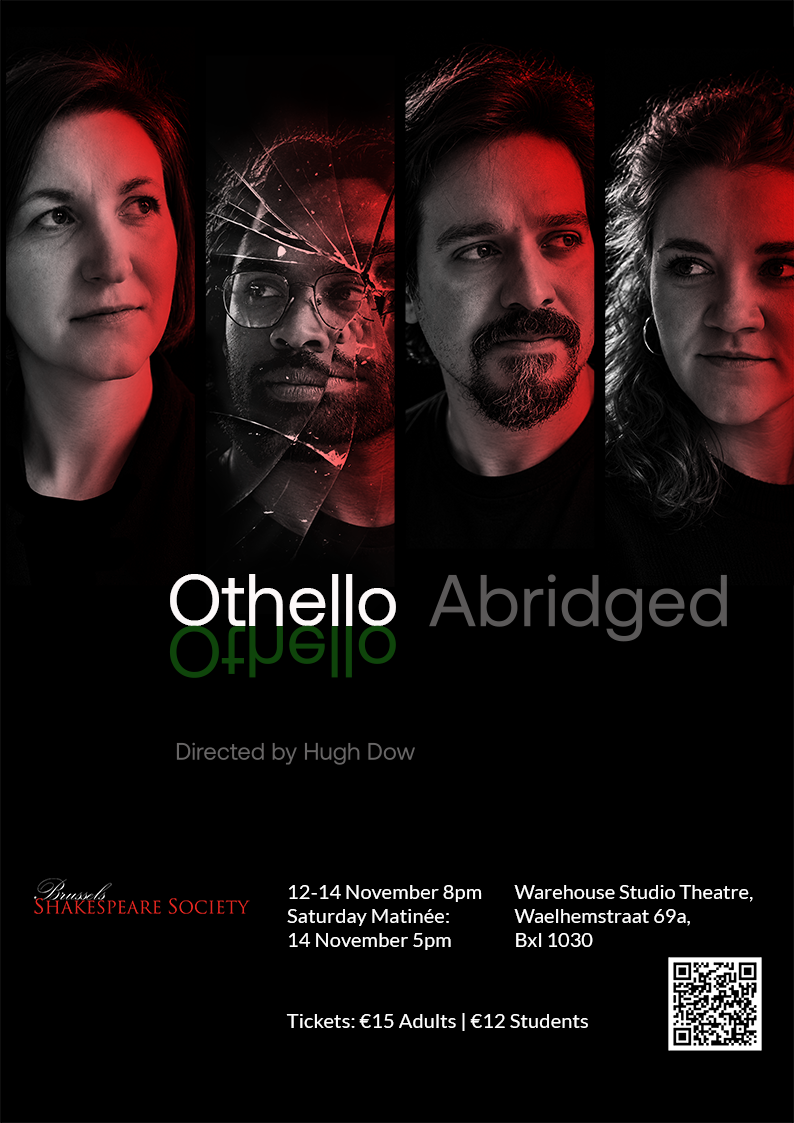
Also On: The Othello Double Bill

Don't forget to see the second part of our semi-annual Shakespeare festival: our special Othello double bill!

The first 45-minute show features the winner of our most recent playwriting competition: Green-Eyed Monster, written and directed by Fintan O'Higgins. The second show is a special, abridged version of Othello, directed by Hugh Dow. Get your tickets now!!

DATES & TIMES
21 – 22 May 2026 at 8:30pm
23 May 2026 at 2:30pm and 8:30pm

VENUE
Centre Culturel Jacques Franck
Chaussée de Waterloo 94, 1060 Saint-Gilles, Brussels

Book Othello Tickets

Green-Eyed Monster & Othello — Double Bill poster

Anti-Disinformation Resources

The themes of this production — propaganda, manufactured narrative, and the manipulation of public truth — are as urgent today as they were in ancient Rome. The following organisations are doing vital work to defend the information environment.

Special Thanks To

The following people provided invaluable help in crafting the set and props for this production.

Squareplum — Dan Ciambrone

Dan Ciambrone is an artist and independent carpenter living in Brussels for the last six years. He has been an active contributor to the theatrical and artistic scene in Brussels and makes things out of wood.

Dimitri Maisuradze

Dimitri Maisuradze, the maker of the ships in our naval battles, writes: “We are a maker duo of brothers specializing in radical, eco-friendly theatre scenography. We transform discarded materials – primarily second-hand wood and recycled cardboard – into highly immersive stage worlds. Our philosophy is simple: there are absolutely no limits. Cardboard and scrap wood aren’t just sustainable; they are the ultimate architectural playground, capable of being engineered and sculpted into literally any shape or structure imaginable. We partner with bold theatre makers who want to push visual boundaries without a massive ecological footprint. You bring the vision, we bring the hands. Let’s run our imaginations wild together and build something unforgettable.”

Join Our Mailing List

Be the first to hear about future Brussels Shakespeare Society productions, events, and news.

* indicates required

Brussels Shakespeare Society will use the information you provide on this form to be in touch with you and to provide updates and marketing. Please let us know all the ways you would like to hear from us:

You can change your mind at any time by clicking the unsubscribe link in the footer of any email you receive from us, or by contacting us at shaksoc@gmail.com. We will treat your information with respect.

We use Mailchimp as our marketing platform. By clicking below to subscribe, you acknowledge that your information will be transferred to Mailchimp for processing. Learn more.

Tickets: billetweb.fr/antony-and-cleopatra